What is Kinesiology?
Kinesiology is a non-invasive, highly integrative holistic therapy, incorporating a range of Western & Eastern techniques as well as Quantum principles & energetic healing tools to support your body’s natural ability to heal itself - physically, mentally, emotionally & spiritually.
The Origins..
Kinesiology has a relatively short history, though it has expanded and evolved rapidly over this time. The origin and “First Wave” of Kinesiology began in 1917 with Dr Robert W. Lovett and his associate Wilhelmine Wright, who developed and published the techniques of ‘Manual Muscle Testing.’ Leading up to the 1950’s slight modifications were made to these techniques, and the growth and application of Manual Muscle Testing was largely linked to the treatment and assessment of Polio sufferers. It was an effective way of assessing the presence and extent of paralysis in each patient and supporting their remaining muscle function from the findings. Of course, this approach was purely biomechanical in nature, and today could be likened to physiotherapy and human movement studies.
Then in 1964, the “Second Wave” of Kinesiology took shape when Chiropractor Dr George Goodheart transformed Manual Muscle Testing from a diagnostic tool into a therapeutic system by linking specific muscle stress to functional disturbances in the body, then treating the root cause of the stress. He discovered that stress in muscles correlated with structural misalignments, nutritional deficiencies, abnormal organ health & dysfunction or stress-related imbalances. By applying targeted interventions (soft-tissue techniques, nutritional support, reflex stimulation) and re-testing the muscle, he confirmed there was functional improvement. This feedback loop of test/treat/re-test became the foundation of “Applied Kinesiology” both a diagnostic and treatment-guided therapy, incorporating musculoskeletal, neurological, biochemical & energetic factors into a unified clinical approach.
The “Third Wave” is Kinesiology as we know it today, having evolved and expanded from the key elements of Applied Kinesiology. Whilst it maintains its strong technical roots, modern Kinesiology has become a uniquely integrated and highly effective form of Energy Medicine, harnessing aspects of Western Therapies, Traditional Eastern Practices & energetic healing methods. This includes a wide range of techniques including Chiropractic, Osteopathy, Physiotherapy, Neurology, Traditional Chines Medicine (meridians, acupressure, five element theory), Ayurveda, Homeopathy, Nutrition, Chakra Systems & Vibrational Medicine Models to name a few. Kinesiology offers a unique approach to exploring the body’s stress responses and patterns of imbalance. Using gentle, non-invasive techniques, kinesiology can help investigate underlying patterns that may be contributing to a person's experience of stress or imbalance, while supporting the body's natural ability to self-heal.

The human body is amazingly complex and sophisticated, with a the ability to self-heal and maintain balance naturally.

Our Bodies are Designed to Self-Heal
We are all divine beings, our bodies intelligently designed to continuously seek a state of homeostasis and balance - structurally, physiologically, mentally, emotionally and energetically. This is also the perspective of modern Kinesiology; that our bodies have an innate capacity to self-heal, supporting our overall health and wellbeing. Stress and health challenges are common in today’s society, and Kinesiology takes the position that these issues can arise when our natural self-healing ability has become disrupted or blocked in some way, preventing our bodies from returning to homeostasis. Kinesiology philosophy is less about healing the individual and more about providing specific support to allow the body’s own natural processes to restore balance.
If we use the example of bones that are out of alignment - from a Kinesiology perspective, this may represent a disruption or imbalance within the body’s communication systems, including the Central Nervous System (CNS). Within the Kinesiology model, muscle monitoring can be used to explore the factors that may be contributing to the bone misalignement and the body’s ability to maintain optimal communication between the brain, nerves and muscles. The contributing factors of the issue explored through Kinesiology may be varied - perhaps there’s one or more suppressed emotions, a past experience or trauma, or even patterns that may have been carried through family or ancestral lines. While some other modalities may address this issue by massaging and loosening surrounding muscles, or physically adjusting the bones themselves, Kinesiology takes a different holistic approach - recognizing the different (but interconnected) layers and influences underlying the stress/imbalance.
Kinesiology uses muscle monitoring as a form of biofeedback communication to connect with the clients subconscious responses, and explore underlying stressors, patterns and areas of imbalance. By working with these responses and addressing associated stress within the kinesiology framework, the aim is to reduce confusion in the body and support the persons natural capacity for self-healing, balance, and optimal function.

According to modern Kinesiology, each and every person has a Central Intelligence of the body that goes beyond the conscious mind.
To some, it’s known as our subconscious, to others it’s considered our spirit or soul - In Kinesiology, we call this our Innate Awareness.
Muscle Monitoring & The Innate Awareness
Muscle Monitoring is a distinctive technique used in Kinesiology. Our Muscles are connected to nerves, which connect and communicate with our spinal cord and brain through the Central Nervous System. When our muscles are monitored in a very specific way (applying a light, graduated pressure) we receive subconscious biofeedback, which is interpreted through changes in the muscle response. Within the Kinesiology framework, this biofeedback is understood as a way of communicating directly with the subconscious mind, or what we call the Innate Awareness. Kinesiologists can interpret the changes in a person’s muscle response to explore information and patterns supplied by the Innate Awareness.
Within the Kinesiology model, our Innate Awareness is believed to hold a vast range of information about what is occurring within us across many different levels of our being, including factors that can be contributing to stress and imbalance. By connecting and communicating with the Innate Awareness, Kinesiologists can follow the thread of information provided through muscle monitoring to explore those underlying stressors and patterns that are associated with an individuals issues and experience.
In the same way, we can use this connection to explore appropriate techniques for addressing the stress and blockages identified. This gentle, non-invasive approach aims to support a person’s natural ability to self-heal and find balance, and help them to let go of the stress and patterns that no longer serve them.
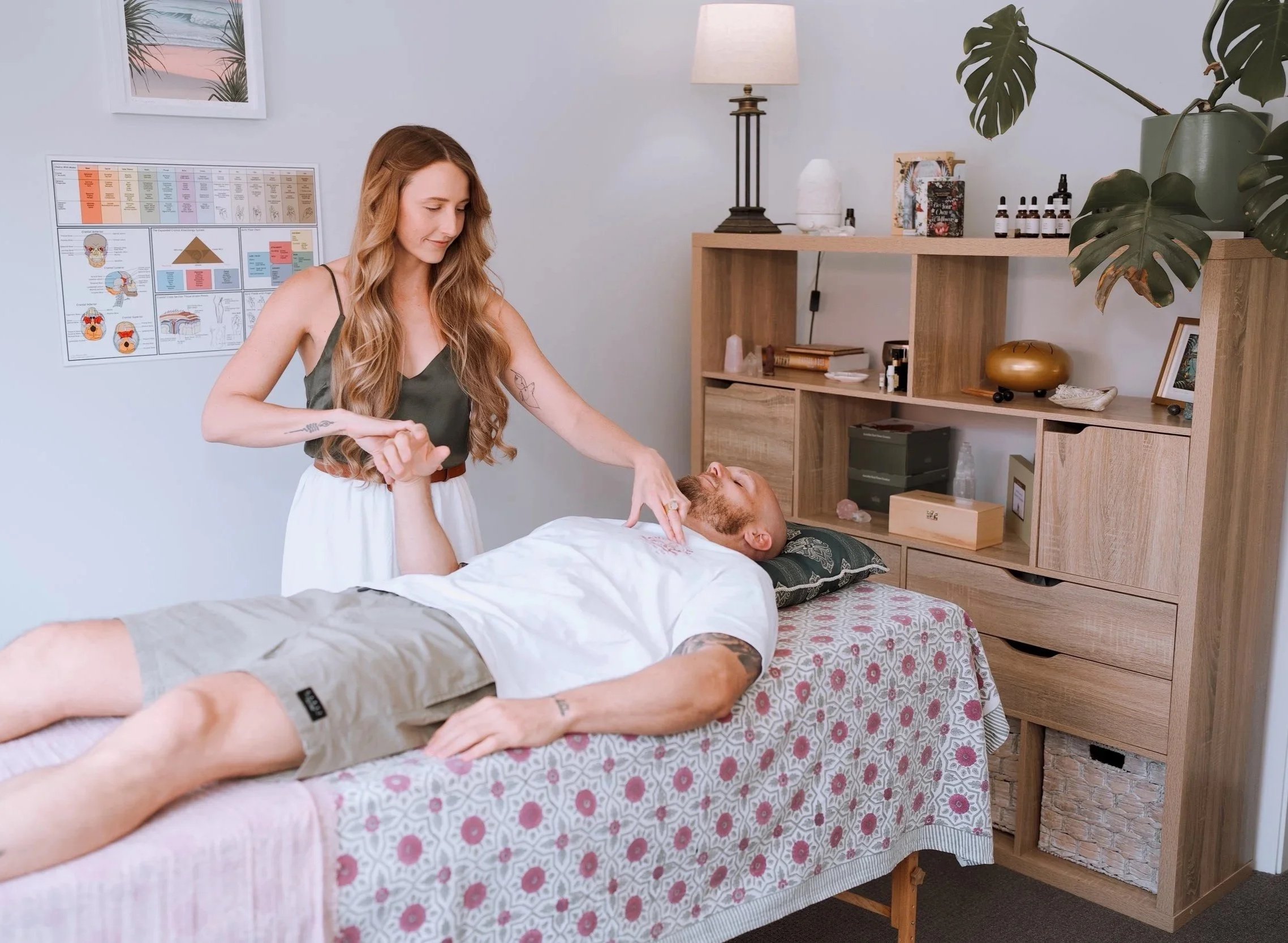

When emotions cannot move, the body must adapt - and imbalance can often be the result.
The Importance of Emotional Resolution
The word Emotion is sometimes referred to as “E-motion” or “Energy in Motion.” Our emotions want to be felt, expressed and processed, so they can move through us unhindered. But when this energy is unable to move freely, our emotions can sometimes feel as though they become “stuck” - contributing to feelings of tension, stress or imbalance. Like many practitioners and authors in the mind-body and holistic health space, I believe there can be meaningful connections between our emotional experiences, mental patterns, and physical wellbeing. From this perspective, a physical symptom or condition may sometimes be explored alongside the emotional patterns that could be connected to it. I personally believe that some unresolved emotions can relate back to experiences from our past - including events, we may still carry emotional charge around.
Sometimes, we may encounter a circumstance similar to one that contributed to an original trauma or difficult experience - which could potentially trigger a similar emotional response in the present. When this emotional charge is repeatedly activated, it can feel incredibly stressful for our system and may leave us feeling mentally and physically depleted - as though our energy is being continually drawn towards managing that unresolved response.
Many people can find it difficult to move through emotional patterns when they aren’t aware of where those patterns have originated, or what experiences may still be influencing them in the present. It is my belief that kinesiology can be a powerful tool for gently exploring underlying emotional patterns, limiting beliefs and experiences that may be contributing to how we feel in the present. By bringing greater awareness to these patterns, kinesiology may support us in processing and integrating them for our highest good.